

 Lara Felsing, Blanket Ceremony for the Forest, May 21, 2023.
 Lara Felsing, Gratitude Blanket detail. Second-hand cotton thread, linen, canvas and floral broadcloth dyed with spruce cones, Saskatoon berries, Sweetgrass, tobacco, cedar, sage, Chaga, strawberries, dandelion and bee pollen, 2023.
Given Alberta’s recent wildfires, I wanted to show gratitude for the forest where I live with a blanket ceremony. The blankets are made from plant pigments I harvested and hand-dyed onto second-hand fabric from the community where I live. The large, abstract squares of fabric represent land from above, and are stitched in the tradition of Métis patchwork quilts. The blankets were placed in the forest near my home as a gesture of care and reciprocity.
The blankets, which I call Gratitude Blankets, measure approximately 80″ X 65″ each, and are sewn onto a civil defence blanket from 1952. The civil defence blankets were part of the National Emergency Strategic Stockpile (NESS). They have been held with food, medical supplies, and other resources in the event of a nuclear attack since the early 1950s in Edson, Alberta. The civil defence blankets were wrapped in bundles and stored in burlap sacks in the town’s Post Office basement. In 2023 they were discovered and were sold off as a fundraiser for the Galloway Station Museum.
The civil defence blankets are repurposed for this project as a gesture towards honouring forests and bringing awareness to the importance of more-than-human communities.
On the day that the Blanket Ceremony for the Forest took place, Alberta recorded the worst air quality on the planet. According to recent research conducted at Colorado State University, trees will essentially “hold their breath” to avoid wildfire smoke. As wildfire smoke disperses over long distances, it undergoes chemical changes as the sun cooks it. It becomes volatile not only for humans but also for plants, insects, birds, and other animals.

Lara Felsing, High Risk (10+). Air quality studies made from wildfire charcoal, fireweed and pine needle castoffs collected at Alberta Wildfire EWF031 burn site, hand-painted onto recycled paper transfers. Mounted onto upcycled birch cradles and sealed with local beeswax. 8″ X 8″ each, 2026.
1) July 23, 2024. Smoke rolling in from neighbouring Jasper wildfires. (View from my backyard)
2) May 5, 2023. First evacuation. (View from my living room window)
3) August 20, 2018. Smoke drifting in to downtown Edmonton from BC wildfires. (Photo courtesy of Terry Reith)
High Risk (10+) is a small series of images from my experiences with extreme wildfire smoke. In 2023, I was evacuated twice due to wildfires near my home. This work is inspired by public health warnings issued during wildfires. Officials advised against outdoor exercise or deep breathing, since harmful particulates can settle deep in the lungs and cause lasting damage. This information led me to track local air quality and investigate the global effects of wildfire smoke and its dangers.
These air quality studies will be on display along with other work from May 20 to July 11, 2026, at the Alternator Centre for Contemporary Arts, Kelowna, BC, in a solo exhibition titled Shallow Breaths.

Berg Felsing and Lara Felsing, Family Ties. Raku, upcycled fabric, air-dry clay, repurposed chopsticks, and paints made from pine needles, wildfire charcoal and fireweed collected at the Alberta Wildfire EWF031 burn site. 2023-2026.
Evacuating during a wildfire involves gathering essentials such as important documents and a few days of food, and coordinating with family members and pets for a safe exit. In May of 2023, we evacuated from our small Alberta town as Wildfire EWF031 and two other large wildfires forced us west as they surrounded our community. In a split second, we had to decide what to take and what to leave behind.
As we drove toward safety, our car loaded with three family members, a sled dog, three cats, and a few days’ provisions, we joined a growing caravan of campers, trucks, and small cars, each loaded to the brim with as much as they could carry.
Driving Highway 16 toward a fluorescent orange sky reflecting the flames behind us, we came parallel to a car overflowing with houseplants, which filled every inch. Plants sat on seats, the dashboard, and even on the driver’s lap, filling the car with lush greenery. It didn’t appear that the driver of the car had evacuated with anything other than their beloved house plants, and we immediately thought of our own beloved houseplants, which until then we hadn’t considered bringing with us.
This mixed-media sculpture was created with my son, and recalls the shared memory as if it were a scene from a science fiction film at a drive-in theatre.
 Lara Felsing, Forest Baskets. Pine needles, twigs, plant-dyed second hand fabric, Sweetgrass, bark, sinew and flagging tape. Approximately 2” X 3.5” each, 2023.
I make small woven baskets using castoffs from the forest floor near my home. Alberta Wildfire EWF031 caused extreme damage to the area, yet there are still gifts embedded in, and on, the land. These small Forest Baskets represent the resiliency of the land, and also the necessity to care for and live in kinship to the natural world.

Lara Felsing, Under a Witness Moon. Plant medicines and wildfire castoffs collected in the forest near my home, repurposed synthetic mesh, cut-out wood frames found at the Banff Centre for Arts & Creativity wood shop. 11.5″ X 11.5″, 2025
This sequence of framed castoffs tells of the rapid changes in the forest near my home. Trees are being removed, garbage is accumulating, and native plants are struggling to grow, all under the watchful eye of the moon.
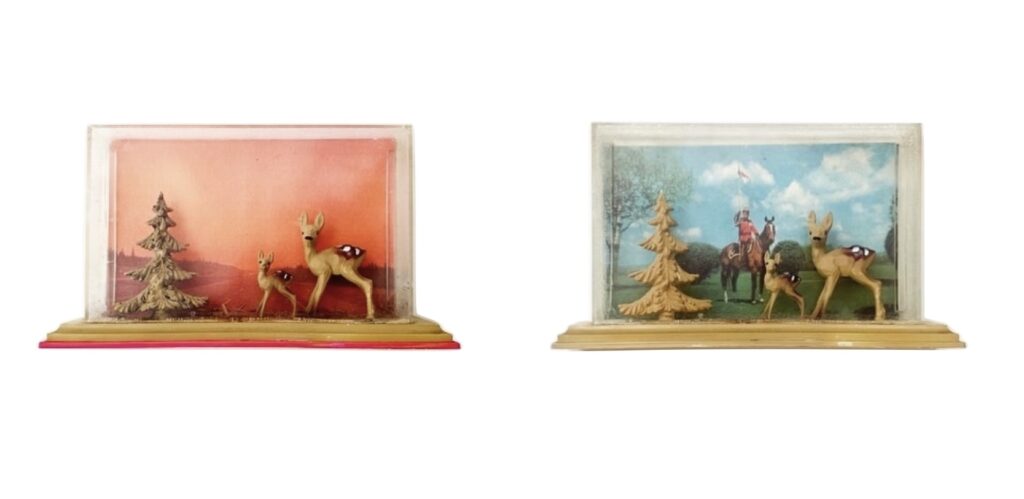
Lara Felsing, Displacement, (Highway 16). Secondhand ornament, wildfire charcoal and pine needles from Alberta Wildfire EWF031, photograph taken by my son, Berg Felsing, during our evacuation from Alberta Wildfire EWF031 in 2023, printed on recycled paper, paint. 2026
My great-grandfather had a similar ornament. (Before image on right. No Mountie, though, just a scenic landscape.) I loved looking at it every Sunday when we would visit him in his little house, at the edge of the forest in a tiny village in northern Alberta.
Inspired by my great-grandfather’s ornament, I have modified the vintage piece to reflect the current state of the forests where I live. Multiple Early Fire Seasons over the past few years have caused extreme wildfire smoke and devastation, displacing not only humans but also birds, insects, reptiles, and other animals.

Lara Felsing, Alberta Wildfire EWF031 (a timeline through photographs). Cyanotypes on handmade paper, harvested plant pigments, remnant embroidery thread, wildfire charcoal from Alberta Wildfire EWF031, dandelion tea, clay and found paint. 7″ X 5″ each, 2023. (Created at the Banff Centre for Arts & Creativity)
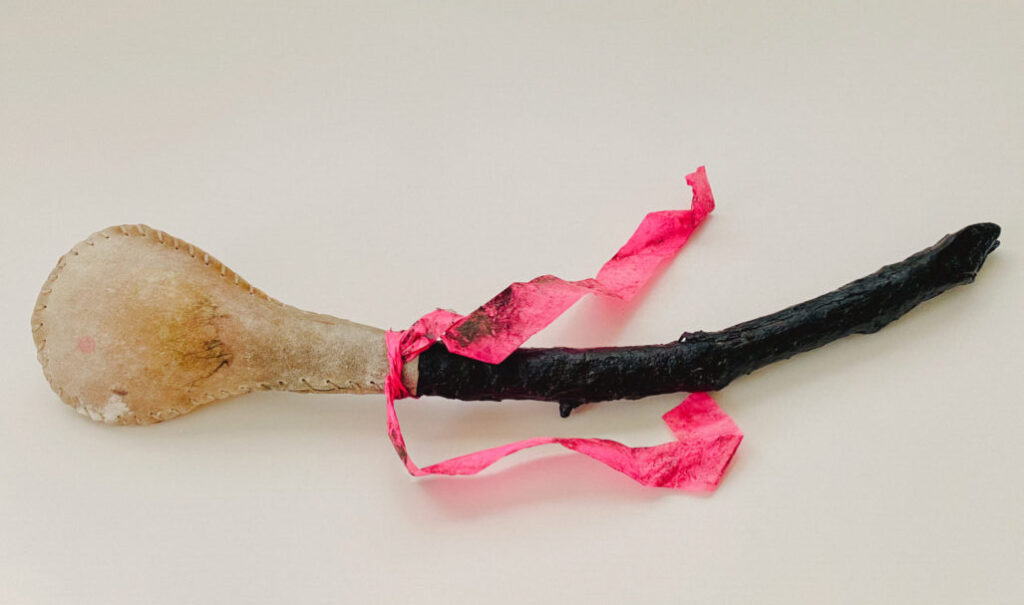
Lara Felsing, Wildfire Rattle. Elk hide, charred branch with flagging tape from Alberta Wildfire EWF031, charred pine needles, sinew, transferred image of wildfire sky, 2026.
During our first evacuation in 2023, the wind was so intense that it carried wildfires over 23 km towards our home overnight, raining charred pine needles and ash down on our house. I’ve made a wildfire rattle filled with charred pine needles, echoing the sound of the falling needles. The handle is a burnt branch found at the burn site, already wrapped with flagging tape. The rattle has an image of a pink sun in the smoke sky, taken from the front window of our home during that time.

Lara Felsing, Wildfire Timeline Windows. Photographs on second-hand fabric and handmade plant pigments on cut-out wood frames found at the Banff Centre for Arts & Creativity wood shop. 11.5″ X 11.5″, 2024
During the wildfires in 2023, I found myself constantly looking out windows. The sky was everchanging, thick with smoke and tinted with unusual pinks, blues and oranges. At one point, charred spruce needles rained down hard against our house, and air quality was so poor we stayed inside for weeks. I took photos from the windows in our home and car before, during, and after our evacuations. The photographs are framed in found wood cut-outs to replicate the uneasy feeling of observing a strange, new but familiar landscape with limited visibility.
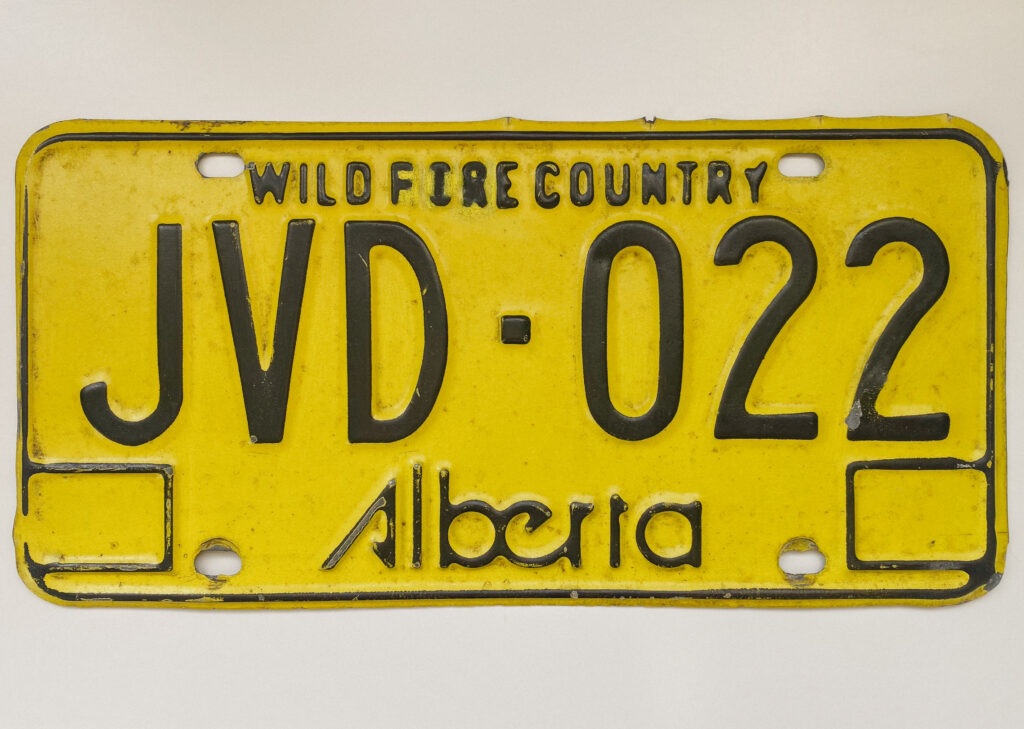
Lara Felsing, Wild Fire Country, Alberta. Secondhand licence plates painted with wildfire charcoal and oil paint, 2026.
Alberta is getting ready to roll out new Strong and Free (provincial motto) licence plates this year. (For over fifty years, Alberta’s licence plates displayed the slogan Wild Rose Country.) In response, I’ve made ten Wild Fire Alberta licence plates, one for each community in Alberta where I, my friends and family have been evacuated from/affected by wildfires over the past few years. The yellow licence plates were in use from 1975 to 1983, and I fondly remember them on vehicles when I was a kid, as yellow was my favourite colour. I now see the yellow on the plates as a warning, indicating a need to proceed with caution during a time of extensive wildfire activity and to prioritize our relationship to the land.

Lara Felsing, Fireweed. Found window with yellow spray paint, dye made from fireweed harvested at Alberta Wildfire EWF031 burn site, wildfire charcoal, secondhand floral broadcloth, thread and sage, 2024. Made at the Bemis Centre for Contemporary Arts, Fireweed honours the strength and resiliency embedded in the land. It encourages viewers to consider their relationship to the land and more-than-humans where they live and beyond.
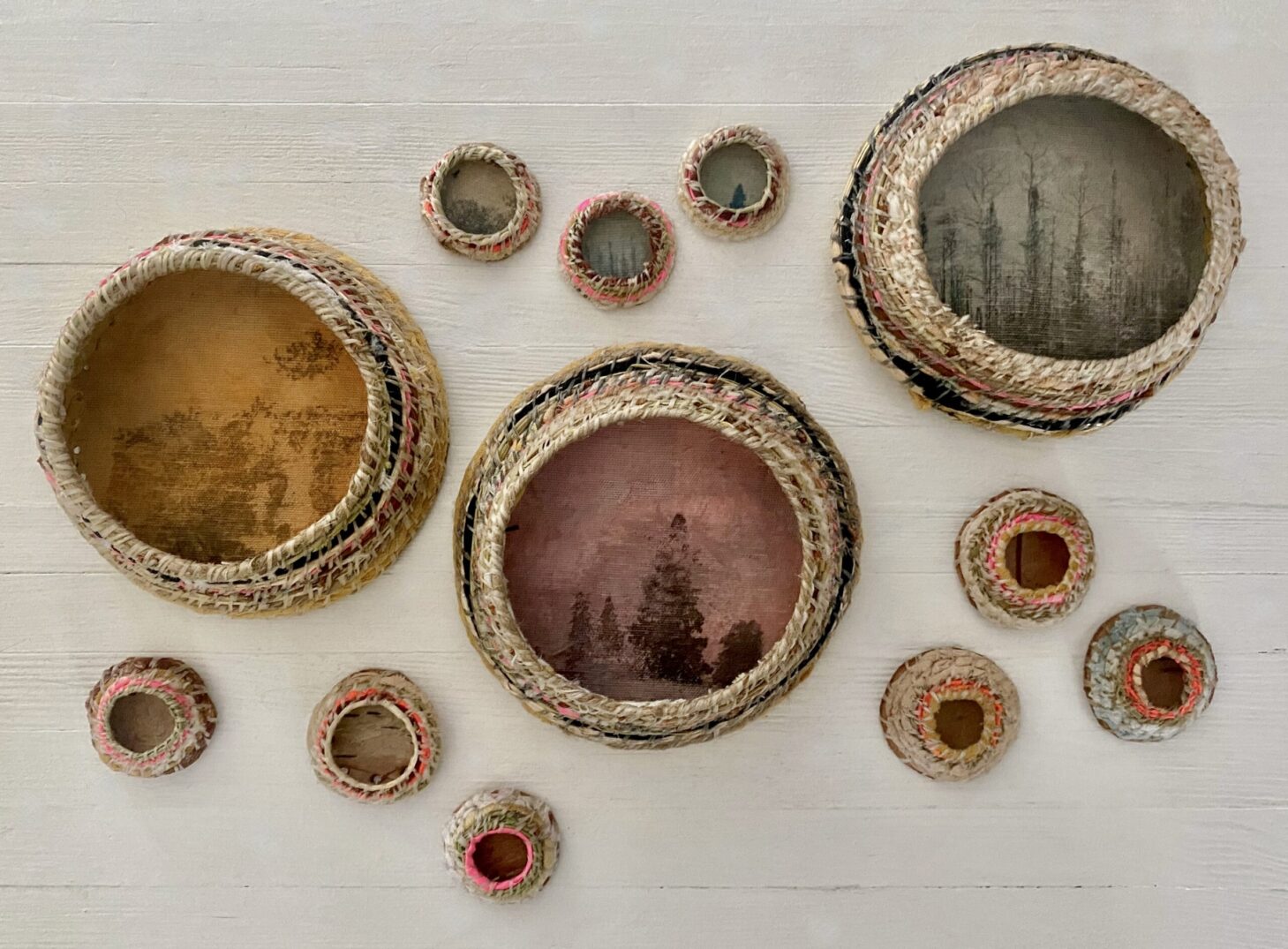
Lara Felsing, Alberta Wildfire EWF031 Baskets. Gifted to delegate leaders at the 2025 G7 in Kananaskis, Alberta, Canada.
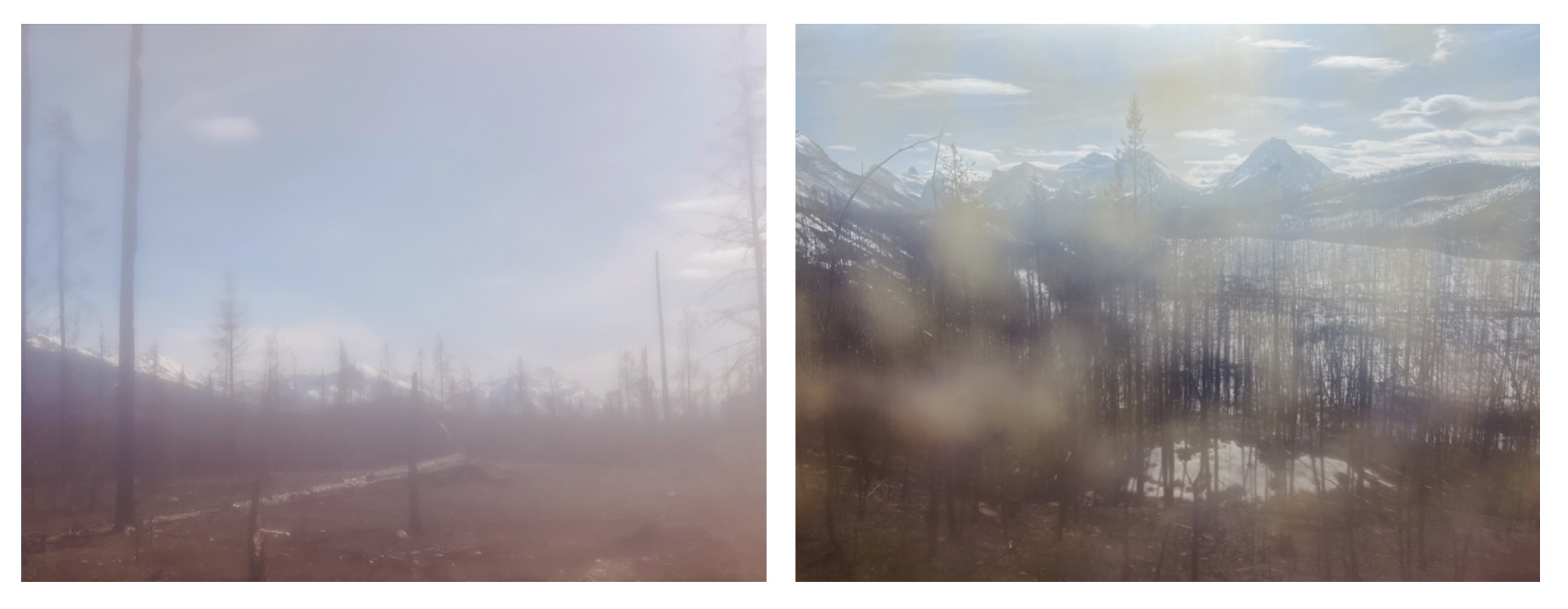
Lara Felsing, After the Fire. Photographs taken with analog filter made with plant medicines, 2025.
Last year, my neighbouring community of Jasper experienced extensive fires, claiming over 358 structures and causing over 20,000 people to evacuate with little notice.
I created an analogue filter by staining thin layers of fireweed and pine onto a glass lens. The season after a wildfire, the land begins to heal under an open canopy where sunlight touches newly dispersed seeds. My photographs capture the forest in an optimistic, dream-like state, where the land prepares for renewal under the witnessing eyes of the mountains.
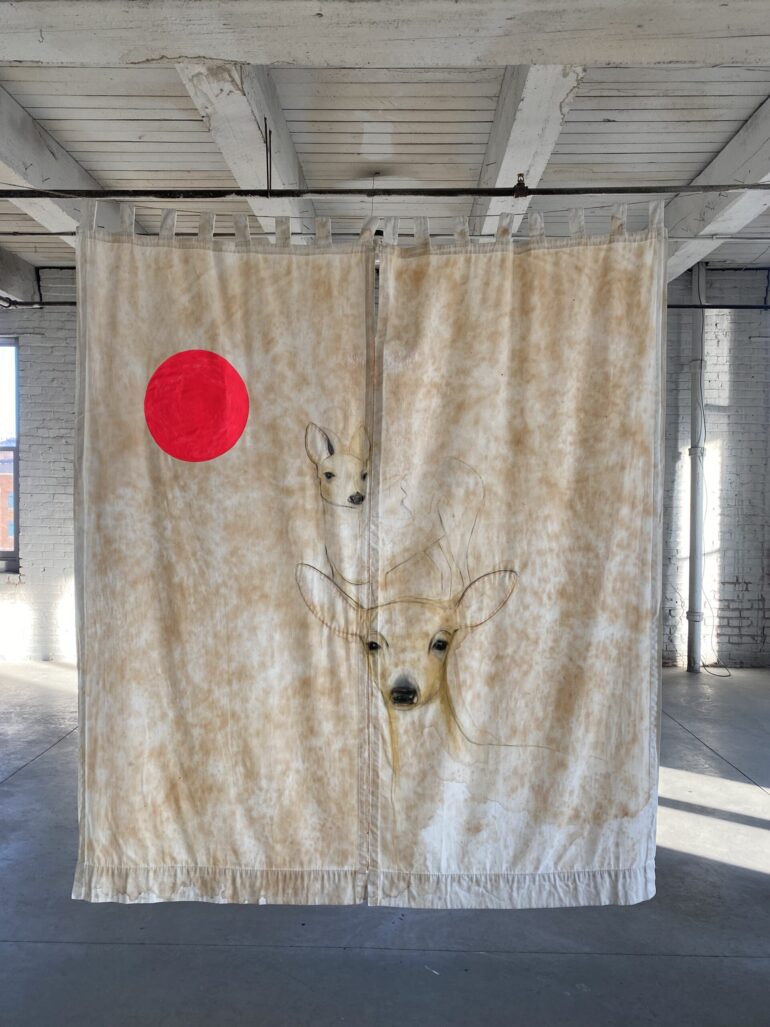
Lara Felsing, Mother and Daughter. Wildfire charcoal, sage, Sweetgrass and pine pigments, secondhand embroidery thread and paint on found curtains, 2024. Created at the Bemis Center for Contemporary Arts.
Mother and Daughter is a life-size painting of two deer painted from a photograph taken by my sister. The photograph was taken one year after we had evacuated twice because of encroaching wildfires. We noticed the deer where we live had less offspring after our community experienced wildfires. Reduced food source, moving habitat and stress affect a doe’s ability to have multiple fawns. This painting is a nod to traditional portraiture, honouring the relationship between parent and child. It acknowledges the more-than-humans with whom we share community, and how they adapt to survive during a time of wildfire.
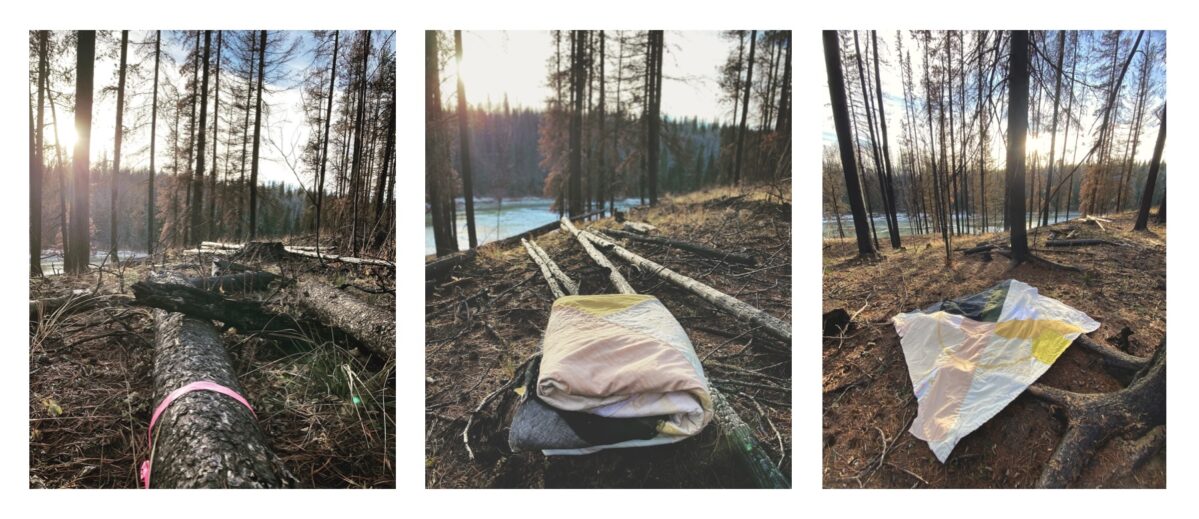
Lara Felsing, Listening to the Land, (Gratitude Blanket). Plant-dyed secondhand fabric and thread hand-stitched onto a NESS civil defence wool blanket. 80″ X 65″, 2024.
Five months after wildfires burned through the forest just over a kilometre from my home, I visited one of the areas where my family and I often spend time. Created at the Banff Centre for Arts and Creativity, this medicine wheel blanket was placed onto the burnt land as a gesture of kinship, and acknowledges the knowledge and gifts embedded in the land and what we can learn from listening.
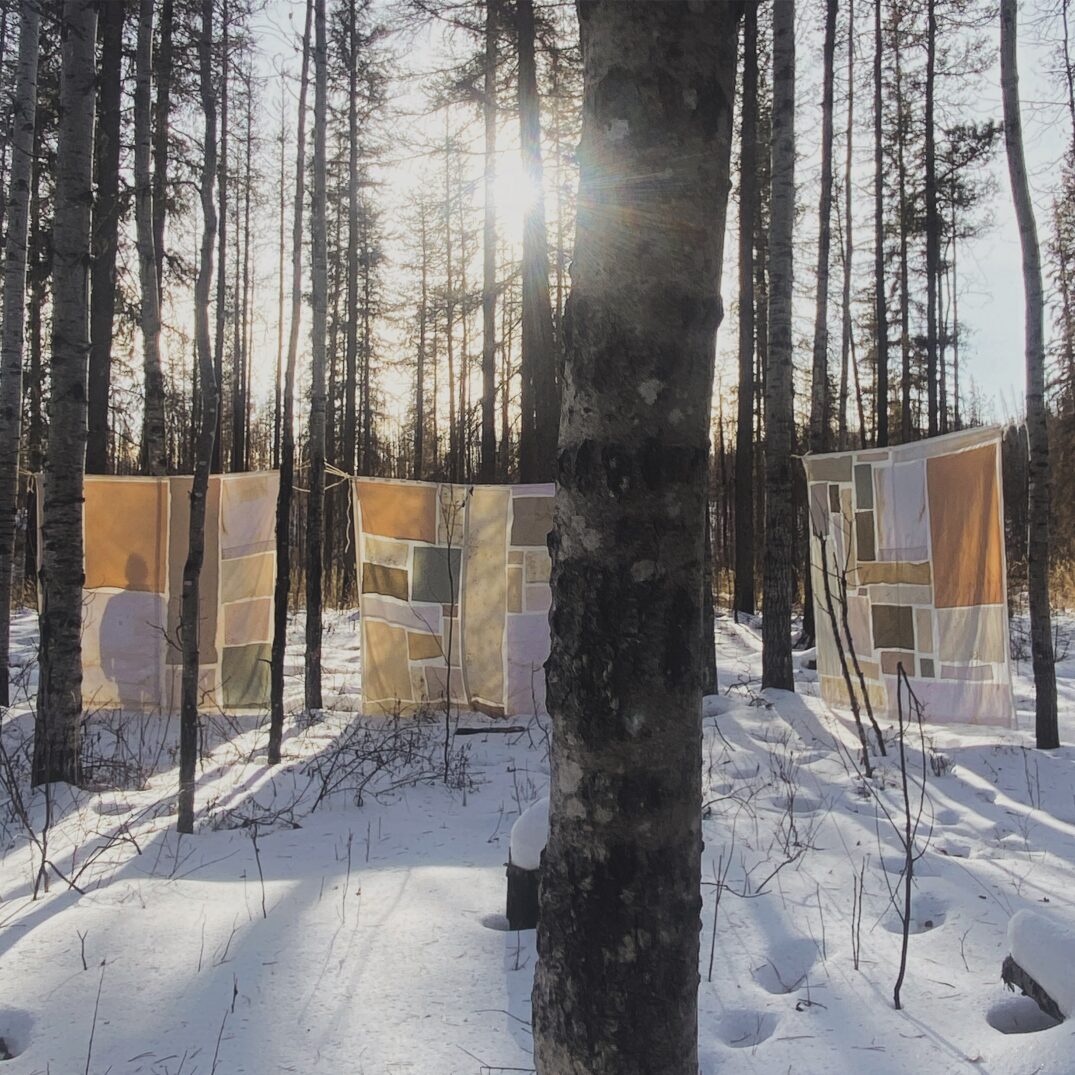
Shallow Breaths, (Air Quality Blankets Photographed at Alberta Wildfire EWF031 burn site). Secondhand fabric dyed with fireweed, sage, Sweetgrass and pine needles, wildfire charcoal and thread.
For the past three years I’ve been tracking the air quality where I live. During my residency at the Bemis Center for Contemporary Arts I stitched hand-dyed fabric together to create abstract patchwork blanket landscapes, and since returning home I have begun applying a layer of wildfire pigment representing the recorded air quality data.
Wildfire smoke contains fine particulate matter invisible to the human eye, which is extremely hazardous to all living beings, soil and waterways. LA County health officials have recently shared that toxic dust is not always visible or detectable on air quality monitors. During the wildfires where I live, I read when exposed to wildfire smoke one should take shallow breaths to prevent particulates from deeply entering the lungs.
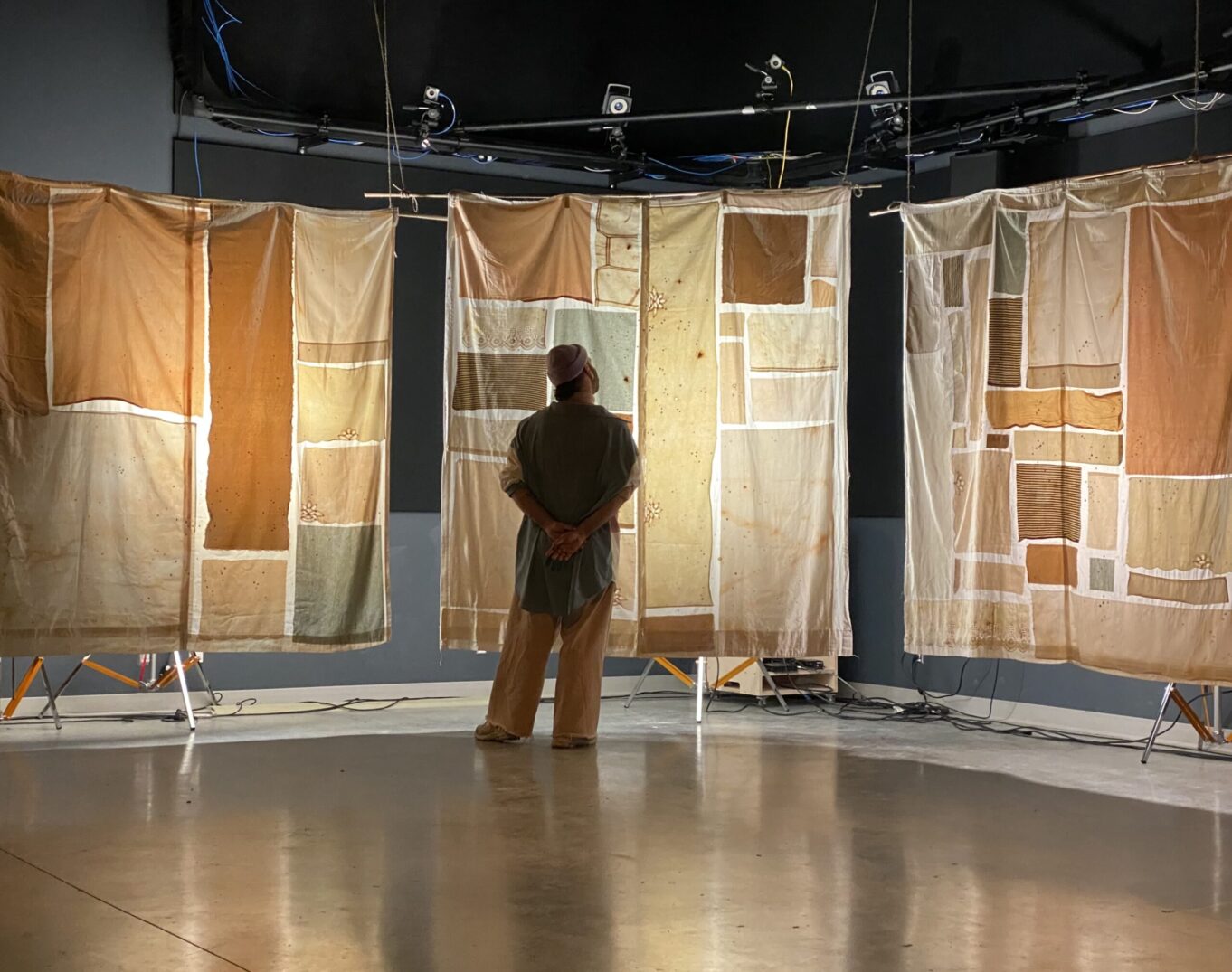
Shallow Breaths, Exhibited at Listening in Relation Equinox Roundtable, Emily Carr University, Vancouver, BC, 2025
The Listening in Relation Equinox Roundtable, March 21-23, 2025 focuses on listening and material making in relation to thought and creative practices in decolonization. Coinciding with the Vernal Equinox, the Roundtable offers Earth-informed, seasonal gathering with a variety of hands-on workshops, sound walks, discussions, exhibitions, listening and making spaces. Workshop leaders and speakers include: Adrian Avendaño, Lara Felsing, Hildegard Westerkamp, Toni-Leah C. Yake.

Lara Felsing, Early Fire Season. Saskatoon berry-dyed second-hand fabric, embroidery thread and pink gouache on an unsigned oil painting purchased at a thrift shop. 2024 (Text from a conversation I overheard while at the local Walmart)
This painting explores concern over the announcement of an early fire season and how it affects the whole community. It voices empathy for the plants, birds, and animals who live in the forest and their well-being during wildfires.
VISIT ME ON INSTAGRAM

